
Residential
Residential polished concrete in Dallas–Fort Worth
Polished and honed concrete for modern homes — living areas, kitchens and garages — for homeowners, architects, interior designers and custom builders who want the slab to be the floor.
Aesthetics
Concrete as an architectural finish
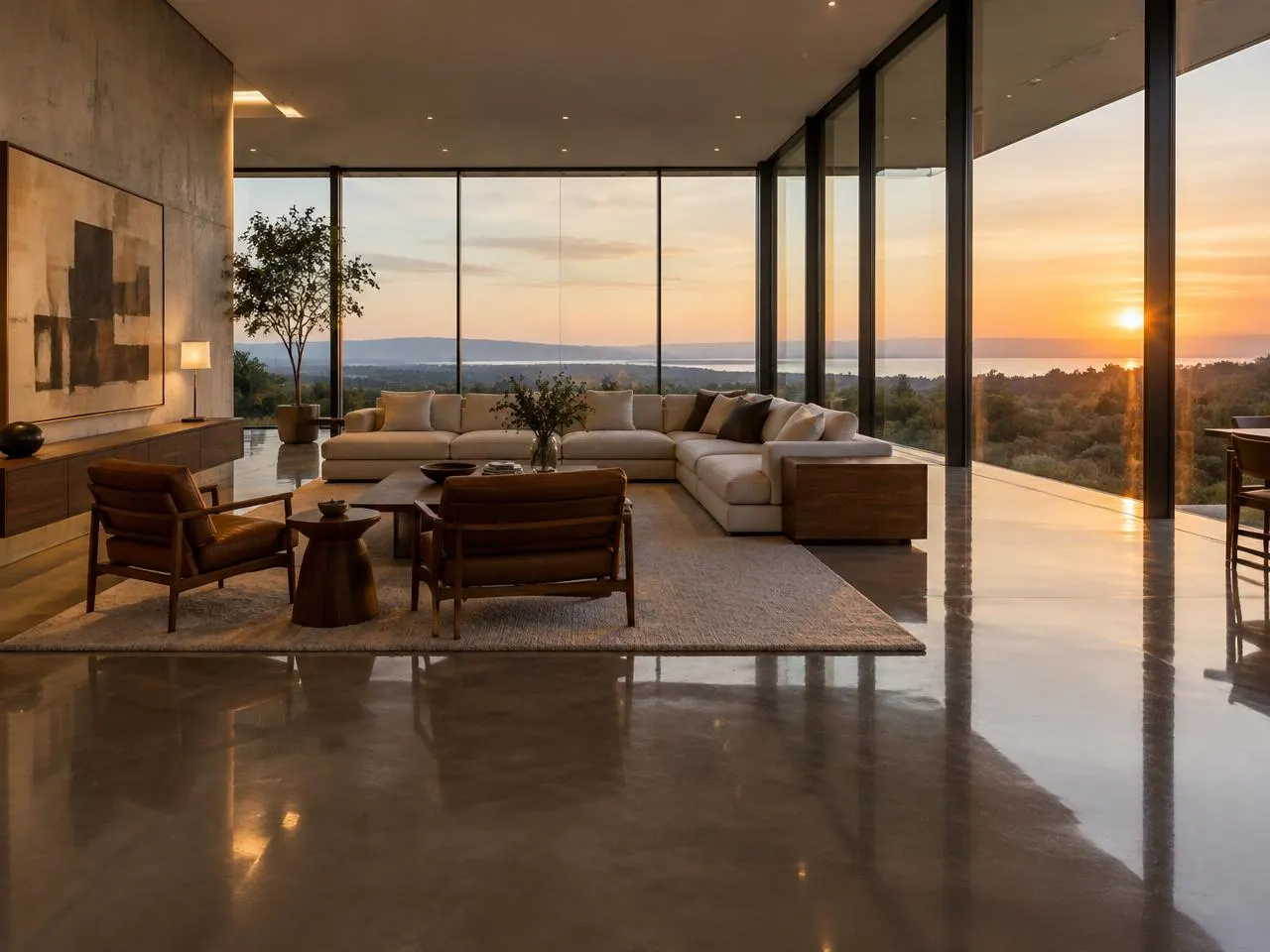
In a home, a polished slab does something few other floors can: it gives a continuous, seamless surface from entry to kitchen to living room, with no transitions, no grout lines and no boards. It suits modern, mid-century and warm minimalist interiors, and works as a quiet base for wood, stone, plaster and steel.
The look is set by two decisions — how much aggregate is exposed and how much sheen the floor carries. The technical detail of both is on our polished concrete page; here's how they translate to a home.
Options
Finish options for homes
Aggregate exposure
- Cream — mostly paste, a smooth, quiet surface. It needs a carefully finished, well-protected slab and is unforgiving of marks.
- Salt & pepper — a fine, even speckle of sand aggregate. Calm at a distance, textured up close, and more forgiving of minor surface variation.
- Exposed aggregate — larger stones visible, a terrazzo-like effect. Best planned before the pour.
Sheen
- Honed — matte, almost stone-like. Very popular in residential design.
- Satin — soft reflection of window light. A good balance of depth and practicality.
- High gloss — mirror reflection. Striking, but shows dust and footprints and takes more upkeep to keep at that level.
Designers and architects selecting finishes for a client can find specification-level detail in our guide for architects and designers.
Expectations
Realistic variation in aggregate exposure
This is the conversation we have with every homeowner, because it's where disappointment comes from. Concrete is not a manufactured tile. Within one slab you'll see:
- Variation in paste colour from batch to batch and from finishing.
- Areas where aggregate sits closer to the surface, and areas where it doesn't — so exposure is never perfectly uniform.
- Cracks, control joints, and on existing slabs, the history: tack-strip holes, old patches, plumbing trenches.
- Small air voids, trowel marks and edge differences near walls.
A test area on your own slab, approved before the full floor, is the most reliable way to set expectations. Photos of other floors — including ones on this site — show what's possible, not a promise of what your slab will look like.
New builds
Planning a polished slab on a custom home
The best residential results come from slabs planned for polishing. If you're building, talk to us and your concrete contractor before the pour about:
- Mix design and aggregate, if a specific exposure is wanted.
- Flatness and finishing technique — burnished, hard-troweled slabs can make cream finishes difficult.
- Curing method — some curing compounds stain or are difficult to remove.
- Control-joint layout, since it becomes part of the finished floor's pattern.
- Protection during framing, drywall and paint — every scrape, oil drip and drywall mud spill is harder to remove later.
Custom builders and remodelers can also use our project inquiry form to start coordination early.
Applications
Premium home applications
- Living areas and open plans on slab-on-grade, where a continuous floor matters most.
- Kitchens — durable and easy to clean, though acidic spills (wine, citrus, vinegar) should be wiped promptly to avoid etching.
- Entries and hallways — high traffic, where a polished slab outlasts most alternatives.
- Garages — ground and polished or sealed, for a clean finish without a coating.
- Covered patios — sealed or honed finishes with traction in mind; outdoor exposure and water are reviewed case by case.
For basements, secondary rooms and areas where budget is the priority, grind & seal may be the better fit.
Care
Living with a polished concrete floor
Maintenance is simple: dust-mop or vacuum regularly, damp-mop with a neutral pH cleaner, and use felt pads under furniture. Avoid vinegar, citrus and ammonia cleaners. Rugs in seating areas soften the room and protect high-traffic paths. Over years, sheen can be refreshed by burnishing or light re-polishing — there's no film to strip.
You can see completed residential and commercial work in our project gallery, or go to our commercial page if you're also planning a business space.
FAQ
Residential questions
Can you polish the existing slab under my flooring?
Often, yes. Once flooring and adhesive are removed, we can assess the slab. Expect to see tack strip holes, old patches, plumbing trenches and cracks — they are part of what an existing slab looks like when polished.
Is polished concrete cold or hard underfoot?
Concrete takes on the temperature of the room and is harder than wood or carpet. Many homeowners use area rugs; polished slabs also pair well with radiant floor heating planned at the pour stage.
What finish is most popular for homes?
Honed and satin finishes in cream or salt-and-pepper exposure are common in modern homes because they read as soft and architectural rather than shiny. High gloss is possible but shows dust and footprints more.
Will the floor be one even colour?
No. Concrete varies within a single pour — in paste colour, aggregate density and small marks from finishing. That variation is the character of the material. A test area shows you what your slab looks like before committing.
Can you polish a new slab during construction?
Yes, and it's the best opportunity for a high-quality result. Talk to us before the pour so finishing, curing and protection are planned for polishing.
What about the garage?
Garages can be ground and polished or sealed. Hot-tyre pickup is a concern with some film sealers, which is one reason polished concrete is often a better fit. We do not install epoxy or flake coatings.
See what your slab looks like polished
We'll assess the floor on site, talk through finish options and recommend a test area before anything is committed. The assessment is free.