
Core service
Grind and seal flooring in Dallas–Fort Worth
Grind & seal is concrete ground to a uniform surface and protected with a sealer. It's a legitimate floor system with its own strengths — and it is not polished concrete. This page explains the difference so you can choose with your eyes open.
The difference
Grind & seal vs. mechanically polished concrete
Both systems start the same way: the slab is ground with diamond tooling to remove the weak surface, contamination and old adhesives, and to set the aggregate exposure. After that they diverge.
Mechanically polished concrete continues through a full sequence of resin-bond diamonds, with densifier, until the concrete itself is smooth enough to reflect light. The sheen is in the slab.
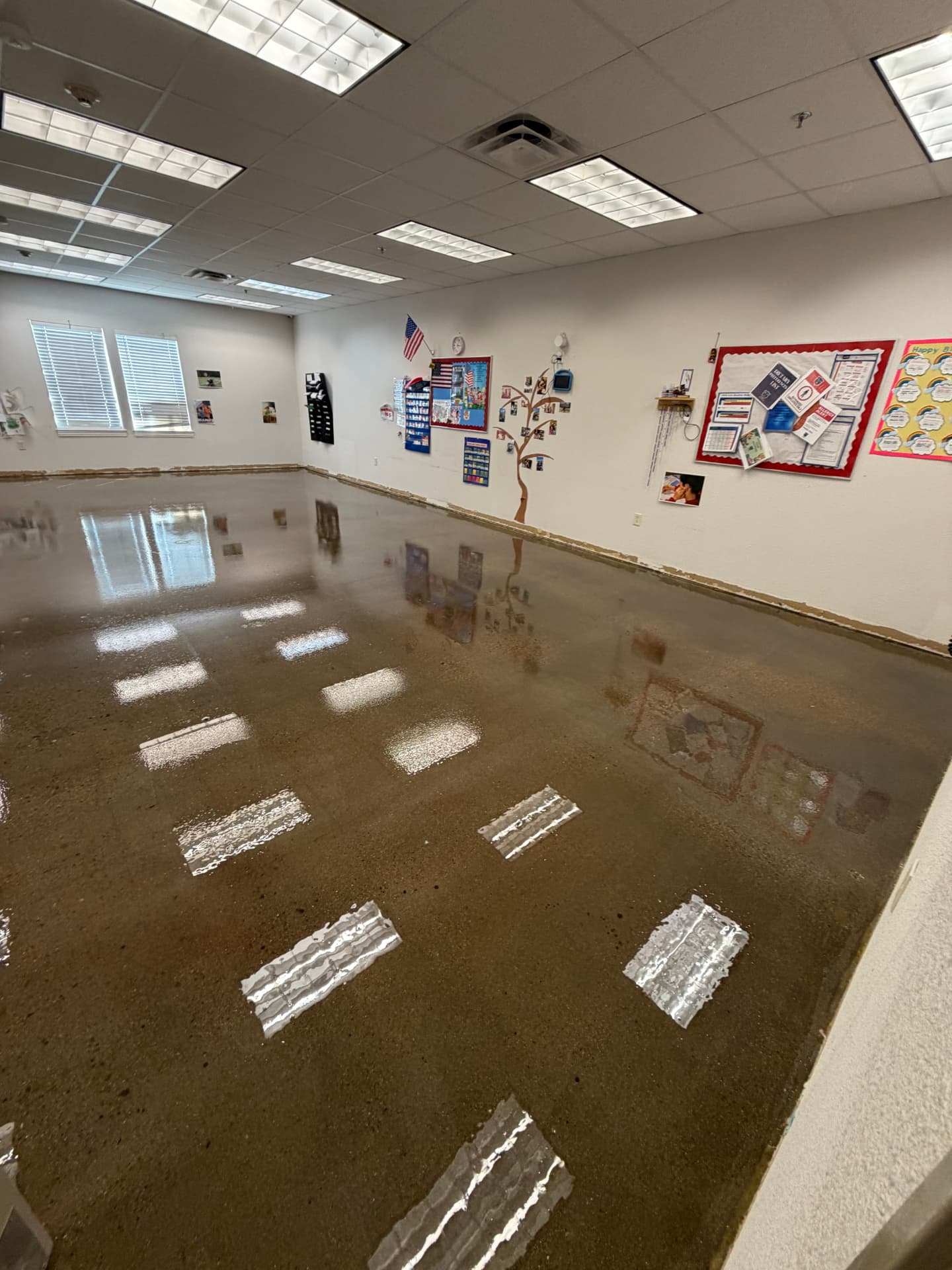
Grind & seal stops after a shorter progression — typically somewhere in the coarse-to-medium range — and applies a sealer. The sealer provides the stain protection and, if it's a film-forming product, most of the sheen. The sheen is on the slab.
| Factor | Grind & seal | Polished concrete |
|---|---|---|
| Where the sheen comes from | Sealer film (or minimal, with penetrating sealers) | Refined concrete surface |
| Grinding steps | Fewer | Full progression to target grit |
| Densifier | Optional | Standard |
| Wear | Sealer wears in traffic lanes; scratches visible | Slow loss of sheen; re-polishable |
| Ongoing work | Periodic clean, screen and recoat | Clean, burnish, occasional re-polish |
| Initial cost | Lower | Higher |
Neither is the “premium” version of the other. They're different tools. A grind & seal floor in the right space can be the smarter decision.
Process
Surface prep and grinding
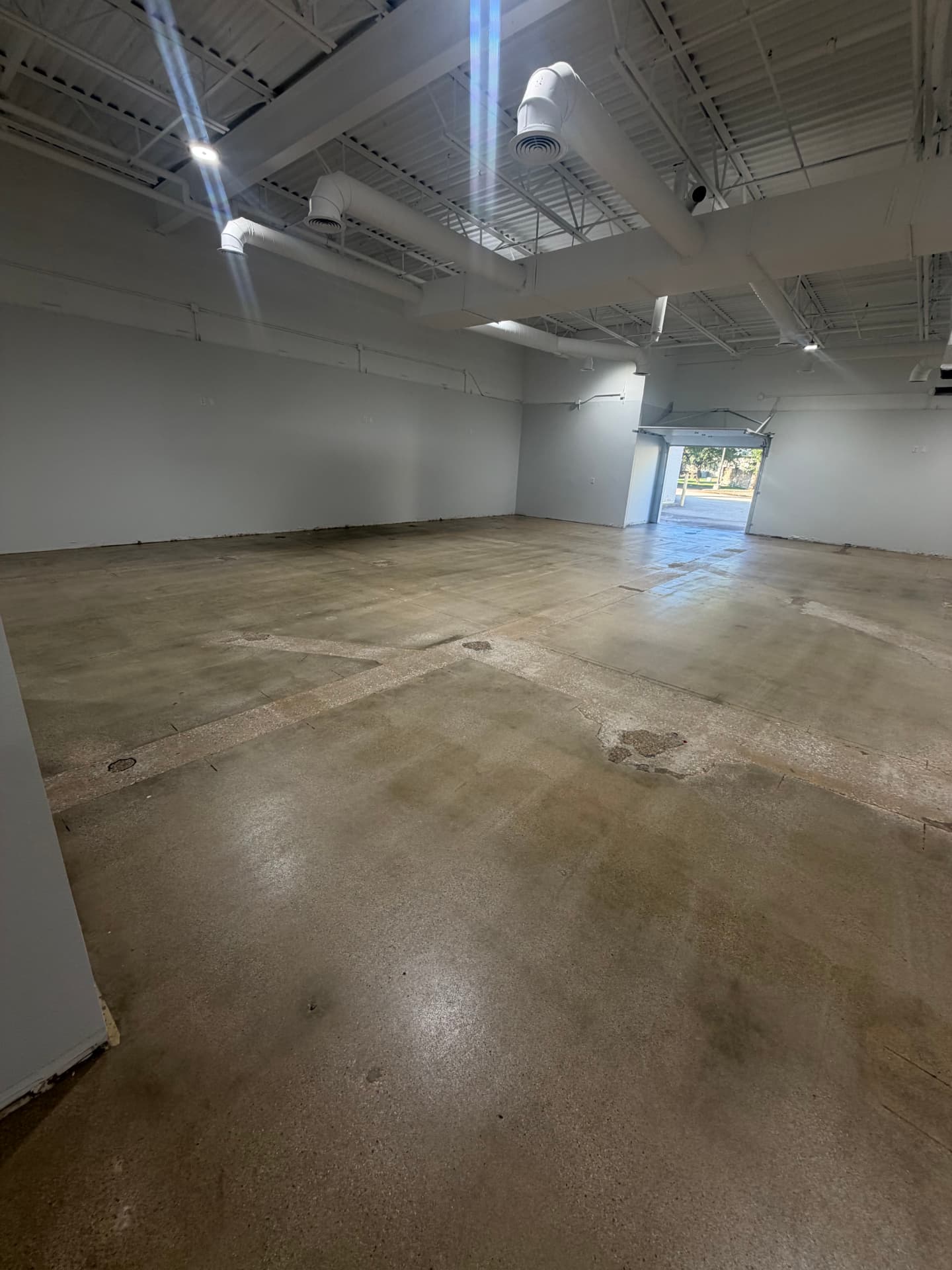
The quality of a grind & seal floor is decided by the grind. Sealers magnify what's under them: swirl marks, missed patches of old adhesive and uneven exposure all become more visible once the sealer goes on, especially under a glossy film.
- Remove what's there. Carpet adhesive, VCT mastic, thinset, paint and curing compounds come off first. This is concrete grinding in the strict sense.
- Set the exposure. Like polished concrete, the grind determines whether you see cream, salt-and-pepper or coarse aggregate.
- Refine to the sealer. Penetrating sealers need a more refined surface to look even; film-forming sealers need the right surface texture to bond, and a clean, dust-free slab.
- Repair. Static cracks and joints are filled where required before sealing. As with polishing, active cracks will reappear.
Dust control matters here as much as on any grinding job. We grind with dust extraction, and the slab is vacuumed and cleaned before any sealer goes down, because trapped dust shows as cloudy patches in the finished film.
Materials
Sealer types
The sealer is the part of the system you live with. The main families:
Penetrating sealers
Silane, siloxane and silicate-based products that soak into the surface and reduce absorption without forming a visible film. They leave the floor looking close to bare ground concrete — matte, natural — and they don't peel or scratch because there's nothing on top. They provide less stain protection against oils than a film and add little or no sheen.
Acrylic sealers
Film-forming, available in matte through gloss. Relatively low cost and easy to reapply, but softer: they scuff and wear quickly in commercial traffic and need the most frequent maintenance.
Urethane and other high-performance film sealers
Harder, more abrasion- and chemical-resistant films. Longer life between recoats than acrylics, but recoating usually requires abrading the existing film for adhesion, and repairs are more visible.
We'll specify a product category and confirm the actual product in our proposal. We don't publish a single “best sealer” — it depends on the space.
Appearance
What a grind & seal floor looks like
With a penetrating sealer: a natural, low-sheen concrete look with the aggregate exposure you chose. With a film-forming sealer: anything from satin to wet-look gloss, with colour deepened slightly by the film. Film sealers can darken the slab and may amber over time with some chemistries.
Up close, a sealed floor shows its sealer — scratches in the film, wear in walking paths, and edges where traffic stops. That's normal and is the main visual difference from a polished slab after the first year or two.
Lifecycle
Recoat cycles and maintenance
A film sealer is sacrificial. It protects the concrete by wearing instead of it, so plan for recoating. How often depends on traffic volume, grit tracked in, the sealer chemistry and the cleaning routine; high-traffic commercial entries wear far faster than a bedroom. We'll give you a realistic expectation for your space rather than a promise.
- Dust-mop daily; grit is the main cause of wear.
- Clean with a neutral pH cleaner. Harsh degreasers and solvents can soften some films.
- Use walk-off mats at entries and felt pads on furniture legs.
- Recoat before the film wears through to bare concrete; once it does, stains get in.
- Avoid layering incompatible products — maintenance coats should match the original sealer chemistry.
Use cases
When grind & seal is the right call
- Budget-driven tenant improvements where a finished concrete look is wanted but a full polish isn't in the number.
- Back-of-house, storage and utility areas where dust-proofing and cleanability matter more than reflectivity.
- Short leases and pop-ups where the floor only needs to last the term.
- Soft or difficult slabs that won't polish to a consistent sheen but will look acceptable sealed.
- Residential spaces such as basements and secondary rooms wanting a natural concrete look with stain protection — see residential polished concrete for primary living areas.
On fit-outs where the schedule is the tightest constraint, grind & seal can also reduce time on the floor. See how we coordinate with other trades on our commercial and general contractor pages.
Limits
Limitations — and when it's the wrong choice
- Heavy traffic and rolling loads. Pallet-jack and forklift traffic wear film sealers quickly. In those environments, polished concrete or a properly engineered industrial system lasts longer.
- Wet areas. Glossy films can become slippery when wet unless an anti-slip additive is used.
- Moisture. Film-forming sealers can blush, whiten or lose adhesion on slabs with high moisture vapour emission. Penetrating sealers are more tolerant. Moisture testing is recommended where it's in question.
- Hot-tyre pickup. Some film sealers soften under hot tyres — a consideration for garages.
- Low-maintenance expectations. If no one will recoat the floor, a film sealer will look worse every year. Polished concrete is the lower-maintenance system over time.
Grind & seal is not a coating system and isn't a substitute for one where a seamless, impermeable or chemical-resistant surface is required.
Next
Comparing your options
If you're weighing both systems, read our polished concrete guide for the full grit, densifier and finish detail. Contractors can send a package through our commercial bid request, and designers can start with specification guidance for architects. Or contact us and we'll assess the slab and recommend one.
FAQ
Grind & seal questions
Is grind and seal cheaper than polished concrete?
Usually, because it involves fewer grinding steps and no fine resin-bond progression. The trade-off is ongoing maintenance: the sealer wears and needs recoating, so total cost over the life of the floor narrows the gap.
How often does a grind and seal floor need recoating?
It depends on traffic, sealer type and how well the floor is maintained. High-traffic commercial lanes wear through faster than a residential room. We'll talk through the expected recoat cycle for the sealer we specify; we don't promise a fixed interval.
Can grind and seal be upgraded to polished concrete later?
Often, yes. The sealer has to be ground off first, then the slab can go through a full polishing progression. Whether it reaches a given finish still depends on the slab.
Will grind and seal look like polished concrete?
From a distance a glossy sealer can look similar. Up close and over time, the difference shows: a sealer sits on the surface and shows scratches and wear lanes, while a polished slab has its sheen in the concrete itself.
Is a sealed concrete floor slippery?
Glossy film-forming sealers can be more slippery when wet than a polished surface. Anti-slip additives can be mixed into some sealers. For wet areas, we discuss lower-sheen penetrating sealers or polished concrete instead.
What sealers do you use?
We choose between penetrating sealers and film-forming acrylic or urethane sealers based on the space, traffic and appearance you want. We'll confirm the specific product for your project in our proposal.
Not sure which system fits?
We'll look at the slab, the traffic and the budget, and recommend grind & seal or polished concrete — whichever actually suits the space.