
For architects & designers
Concrete flooring specifications for Dallas architects and designers
Practical guidance for selecting and specifying polished concrete — what to call out, what to leave to the mockup, and where the material's natural variation needs to be set as an expectation with your client.
Selection
Finish selection: two decisions, made separately
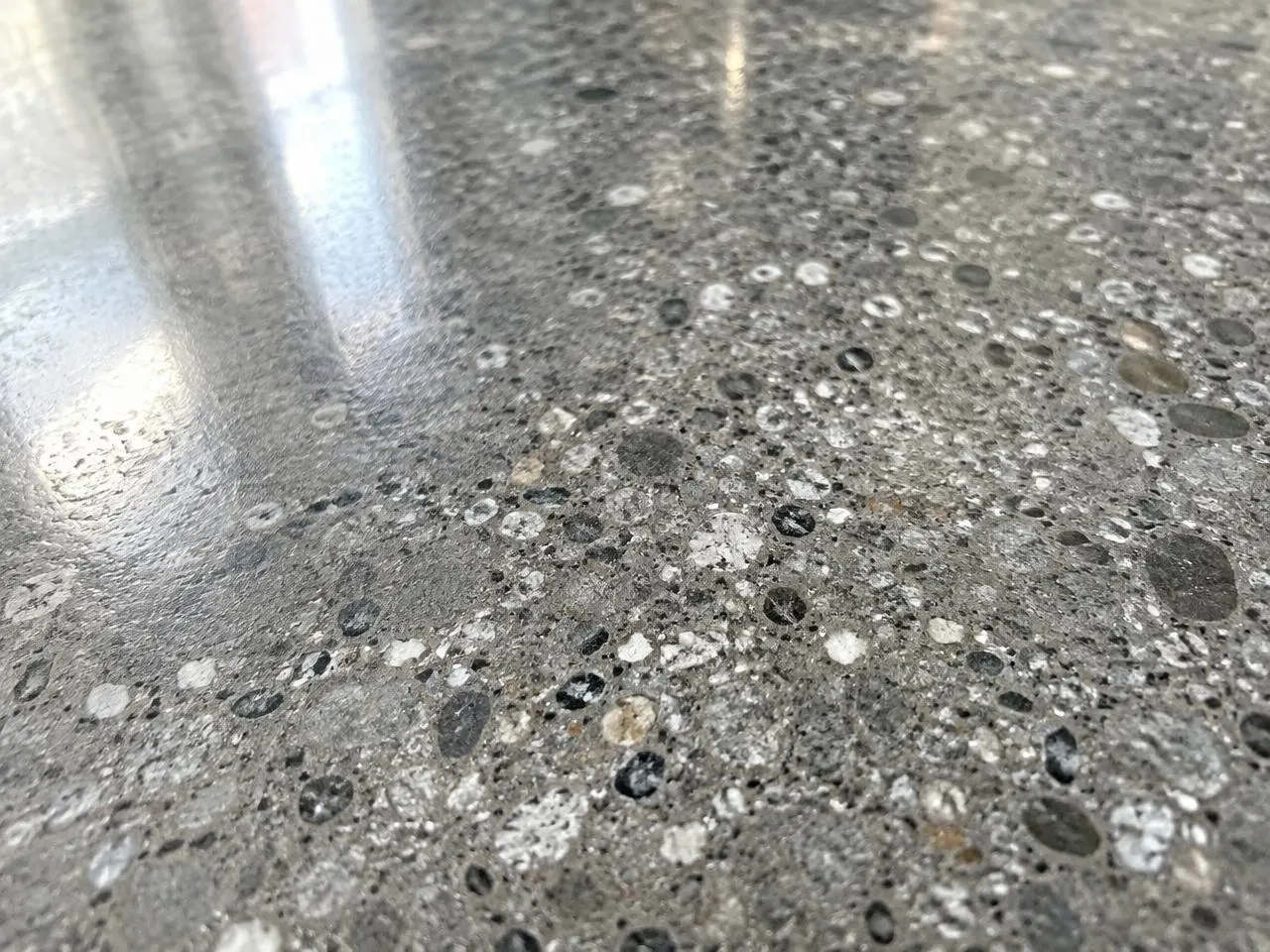
A polished concrete finish is defined by aggregate exposure and sheen level. They're independent: a cream finish can be honed or highly polished; exposed aggregate can be matte or glossy. Specifying them separately avoids the ambiguity of terms like “polished concrete, satin” that leave exposure open.
For the underlying process — grit progression, densifiers, guards — see our polished concrete technical overview. For lower-cost sealed finishes, see grind & seal.
Exposure
Aggregate exposure
| Class | Description | Specification note |
|---|---|---|
| Cream | Paste surface, minimal aggregate | Requires a flat, carefully finished and protected slab. High risk on existing slabs. |
| Fine (salt & pepper) | Fine aggregate exposed in an even speckle | Most forgiving and most common in commercial interiors. |
| Medium / large | Coarse aggregate exposed | Most removal; uniformity depends on flatness and aggregate distribution. Plan mix design on new pours. |
On existing slabs the aggregate is whatever's there. On new construction, coordinate exposure with the concrete contractor at mix design and finishing stages.
Appearance
Colour and sheen expectations
Sheen is usually described as ground, honed, semi-polished (satin) or highly polished. If you specify a gloss reading, also specify the instrument, the angle and where readings are taken, and approve the result at the mockup. Higher sheen shows dust, scratches and footprints more readily; for restaurant and wet-adjacent areas, satin is usually the more practical selection.
Natural grey concrete has no single colour. Paste tone varies with cement, mix and finishing, and changes slightly once densified and guarded. Dyes can shift tone but don't eliminate variation. We don't recommend colour-matching to a sample chip.
Variability
Appearance variability — setting expectations early
Write these into the specification or the client brief so they're not surprises at punch list:
- Aggregate exposure varies with slab flatness; perfectly uniform exposure is not achievable.
- Cracks, joints, patches, saw cuts and core holes remain visible.
- Paste colour varies between pours and within a pour.
- Edges along walls and around columns may differ slightly from the open field due to edge-grinding equipment.
- Existing contamination may leave permanent staining.
Limits
Slab limitations and surface prep vs. finish
Not every slab can achieve every finish. Soft concrete, poor flatness, heavy patching and deep contamination all limit results — see slab-condition limits for the detail. On tenant-improvement projects we recommend a slab assessment before the finish is finalised.
It's also worth separating surface preparation from finish specification. CSP (concrete surface profile) numbers describe a texture prepared for a bonded material — a coating, overlay or adhesive. They're appropriate in prep scopes for other trades, but a CSP value is not a polished concrete finish and shouldn't stand in for one.
Approval
Mockups and specification considerations
A mockup on the actual slab — or on a test panel from the same pour on new construction — is the single most effective tool for aligning client, designer and installer. We recommend specifying:
- Mockup size and location, approved in writing before full production.
- Approved mockup retained as the standard of acceptance.
- Exposure class and sheen level by name, plus gloss reading method if used.
- Densifier, guard and joint filler by type, with product data submitted.
- Protection requirements after polishing, and responsibility for them.
- Maintenance instructions delivered to the owner at handover.
- Slab-placement requirements on new pours: finishing, curing method (avoid curing compounds that stain), and joint layout.
Physical sample boards are provided only on request, not as a standard part of every project. General contractors pricing your drawings can send packages through our GC bid request. For residential clients, our residential page explains finish options in plain terms, and the commercial page covers coordination on TI projects.
Specification support
Talk through a specification
Tell us about the project and finish you're considering. We'll respond with practical notes for your slab and schedule.
FAQ
Specification questions
How should I specify aggregate exposure?
Name the exposure class (cream, fine/salt-and-pepper, or medium/large exposed aggregate) and require a mockup for approval, rather than relying on a photo reference.
Should I specify a gloss reading?
You can, but specify the measurement method and where readings are taken. Many specifiers describe the sheen level (ground, honed, semi-polished, highly polished) and approve it at the mockup.
Can I specify a uniform colour?
Not with natural grey concrete. Dyes can shift colour, but paste and aggregate variation still show. If uniformity is essential, polished concrete may not be the right material.
Is CSP the right way to specify a polished floor?
No. CSP describes surface profile for bonded materials such as coatings and overlays. It's useful in prep scopes but doesn't describe a polished finish.
When should we involve you?
Ideally before the slab is poured on new construction, so finishing, curing, joint layout and protection can be planned. On existing buildings, before finishes are finalised so slab conditions can inform the selection.
Do you provide product data?
Yes — data for the densifier, guard and joint filler we propose, plus our maintenance instructions.