
Core service
Polished concrete in Dallas–Fort Worth
Mechanically polished concrete is a slab ground, densified and refined through finer and finer diamonds until the concrete itself reflects light. No coating, nothing to peel. Here is how it works, what it can and can't do, and how to keep it looking right.
Definition
What “mechanically polished” actually means
The term gets used loosely. Some contractors call any shiny concrete floor “polished”, including floors that are lightly ground and covered with a glossy sealer. In this industry, mechanically polished concrete has a narrower meaning: the slab is ground with metal-bond diamond tooling, treated with a chemical densifier, and refined through a sequence of resin-bond diamonds to a specified level of reflectivity. The shine comes from the flatness and fineness of the concrete surface, not from a product applied on top.
That distinction matters for the life of the floor. A film-forming sealer wears in traffic lanes and has to be stripped and reapplied. A mechanically polished surface wears much more slowly and can be brought back by re-polishing with fine grits — no stripping, no recoating. If budget or schedule rule out a full polish, grind & seal is the honest alternative, and we explain the trade-offs on that page.
Process
Grit progression, and why it varies
Every polished floor is built from a sequence of diamond grits. Lower numbers are coarser and cut faster; higher numbers are finer and refine the scratch left by the previous step. A typical sequence starts with metal-bond tooling in the 16–30 range to open the slab, moves through 60–120 metal or transitional tooling, then into resin-bond pads at 50, 100, 200, 400, 800 and higher depending on the target sheen.
The sequence is not fixed, and anyone who quotes the same steps for every floor hasn't looked at the slab. Grit progression depends on:
- Slab hardness. Hard, well-finished slabs resist the diamonds and may need softer-bond tooling or more passes. Soft slabs cut fast but can be torn up by aggressive tooling and may need densifying earlier.
- What has to come off. Adhesive, thinset, paint, coatings and curing compounds have to be removed before the real progression starts. That is concrete grinding, not polishing, and it adds steps.
- Aggregate exposure target. A cream finish avoids cutting deep; an exposed-aggregate finish removes several millimetres. The coarse steps change completely.
- Target sheen. Stopping at 400 resin gives a honed or satin look. Going to 800, 1500 or 3000 gives progressively higher reflectivity.
The rule that holds across all of them: never skip a step to save time. Each grit has to remove the scratch from the previous one. Skipped steps leave visible scratch patterns that show up under raking light and low sun through storefront glass.
Chemistry
Densification: what the chemistry is doing
Concrete paste contains calcium hydroxide, a by-product of cement hydration that adds little strength. Silicate densifiers — sodium, potassium or lithium based, and colloidal silica products — react with that free calcium hydroxide to form additional calcium silicate hydrate, the same binder that gives concrete its strength. The result is a harder, less porous surface layer that can take a polish and resists dusting and abrasion.
Densifier is typically applied after the coarse grinding steps, once the slab is open and can absorb it, and before the finer resin steps. Lithium silicates are popular because they react with less residue and are less likely to leave a white haze, but the right product depends on the slab and manufacturer's system. Densifier is not a sealer and does not make concrete stain-proof; that is the job of the guard applied at the end.
On existing floors that have lost their polish, a fresh densifier treatment as part of a restoration — light grind, densify, re-polish — often brings the floor back without starting from scratch.
Appearance
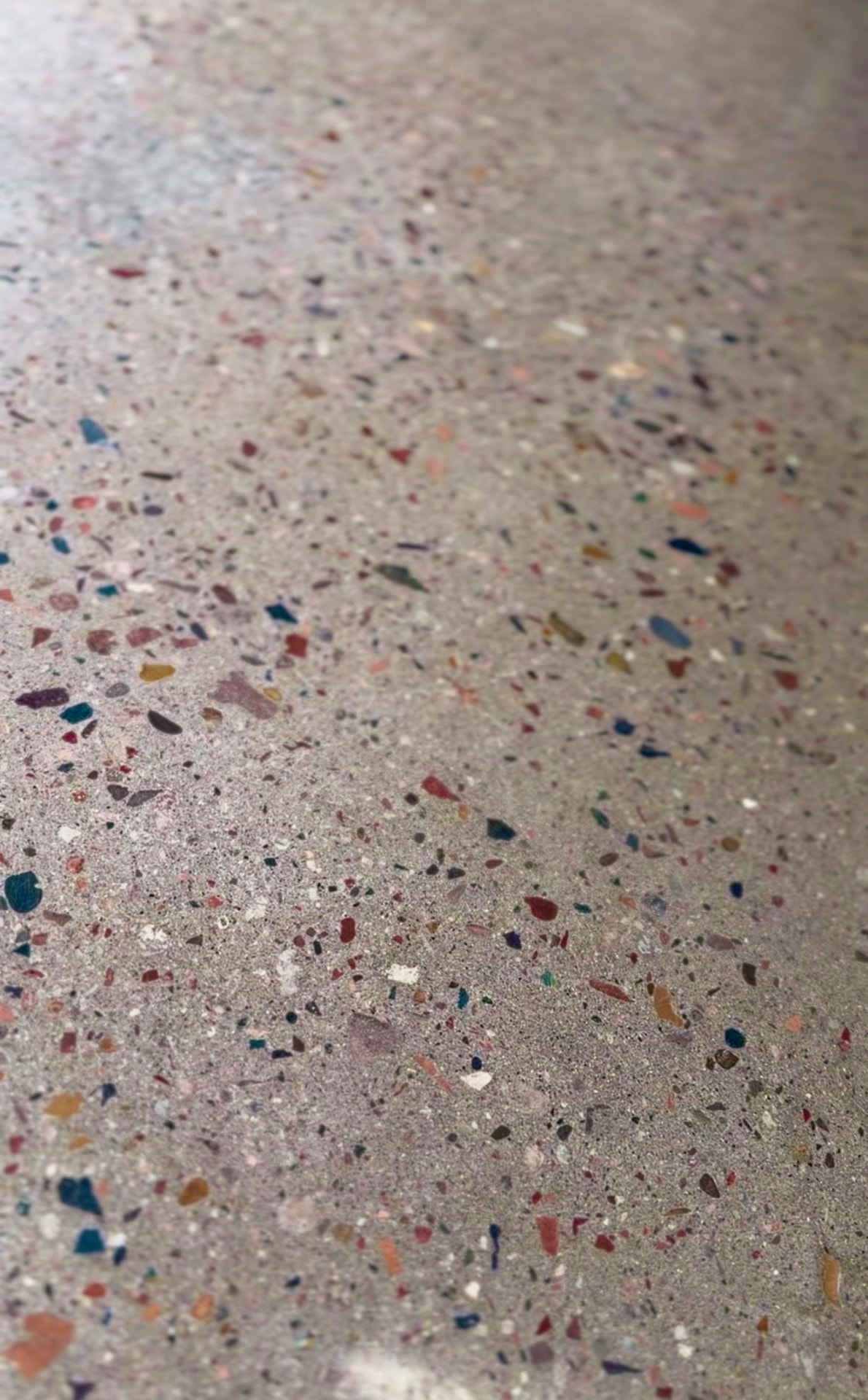
Aggregate exposure: cream, salt & pepper and exposed
How deep we grind sets the look, and it's the decision with the least room for second thoughts — you cannot put the paste back. The industry recognises three broad classes:
| Class | What you see | Notes |
|---|---|---|
| Cream | Mostly cement paste, little or no aggregate visible | Needs a flat, well-finished slab with no trowel burns or patching. Least material removed; least forgiving of surface defects. |
| Salt & pepper | Fine aggregate (sand) exposed in an even speckle | The most common commercial look. Hides minor surface variation well. Requires a reasonably flat slab for even exposure. |
| Exposed aggregate | Medium to large coarse aggregate exposed | Most material removed. Exposure will be uneven on slabs with poor flatness or uneven aggregate distribution. |
On new construction, the finish can be planned before the pour — mix design, aggregate, finishing technique and protection during construction all affect what's achievable. On existing slabs, you get the aggregate that's there. We'll show you what's under the surface with a test area before committing.
Sheen
Honed vs. high-gloss, and everything between
Sheen is controlled by the final grit and the burnishing that follows. Most specifications describe four levels: ground (flat, no reflection), honed (matte, very low reflection), semi-polished or satin (soft reflection of overhead lights), and highly polished (clear, mirror-like reflection). Gloss meter readings and distinctness-of-image measurements are sometimes specified; we can take readings at handover where the specification calls for them.
Higher is not automatically better. High gloss shows dust, footprints and scratches more readily and takes more effort to maintain at that level. In restaurants, back-of-house areas and entries exposed to water, a satin finish is usually the more practical choice. Residential clients often favour honed or satin finishes for a softer, architectural look.
Suitability
Where polished concrete works — and when it's the wrong choice
Polished concrete performs well in dry interior spaces with steady foot traffic: retail, offices, showrooms, restaurant dining rooms, lobbies, studios and homes on slab-on-grade. It handles rolling loads well; pallet-jack traffic is routine on polished slabs, and forklift traffic is fine on slabs designed for it, though hard wheels and turning will wear a high-gloss finish faster. See our commercial polished concrete page for how we coordinate on tenant-improvement schedules.
It is the wrong choice when…
- The slab is too soft, badly cracked, heavily patched or out of flatness to give the look the client expects — and there's no budget for an overlay or replacement.
- The space needs a seamless, chemical-resistant or impermeable surface — commercial kitchens, labs, some healthcare rooms. Polished concrete is dense but not impermeable.
- The floor will see constant standing water or grease, where traction is a concern regardless of finish.
- The client expects a uniform, colour-consistent floor with no cracks or variation. Concrete is a natural material and will show its history.
- The slab has an unresolved moisture problem or is contaminated deep with oil that grinding can't remove.
We would rather tell you this at the walk-through than at punch list.
Limits
Slab condition, contamination and moisture
Before anything else we look at the slab. Things that limit polished results:
- Flatness. Grinders follow the surface. On a wavy slab, high spots expose aggregate while low spots stay in cream. Uniform exposure requires a reasonably flat floor.
- Surface defects. Trowel burns, delamination, curing-compound residue, overspray and old patching all show through.
- Cracks and joints. Polishing doesn't hide cracks. Static cracks can be filled; active cracks will reopen through any filler. Control joints are typically filled with a semi-rigid polyurea or epoxy joint filler where specified.
- Contamination. Oil, grease and some chemicals penetrate deep and can leave permanent dark staining.
- Moisture. Polished concrete itself is breathable and tolerant of moisture vapour, but moisture affects densifier performance, dyes and any guard or joint filler applied. Where moisture is a question, we recommend testing before work begins.
It also helps to separate surface preparation from finish specification. A CSP (concrete surface profile) number describes the texture left for a bonded material such as a coating or overlay — it is not a polished-concrete finish specification. Architects can find more on this distinction in our specification guidance.
Comparison
Polished concrete vs. coatings vs. VCT
A neutral comparison, because the right floor depends on the space:
| Factor | Polished concrete | Epoxy / resin coatings | VCT |
|---|---|---|---|
| Surface | The slab itself, refined | A bonded film on top of the slab | Tiles glued to the slab |
| Wear pattern | Slow loss of sheen; re-polishable | Can scratch, wear through or delaminate | Tiles wear, chip and lift |
| Maintenance | Neutral cleaner, auto-scrubber, periodic burnish | Cleaning; recoat as it wears | Regular stripping and waxing |
| Seamless / impermeable | Seamless but not impermeable | Yes, when properly installed | No — seams |
| Appearance | Natural variation, cracks visible | Uniform colour possible | Uniform pattern |
| Depends on slab quality | Highly | Less, with proper prep | Least |
We polish and seal concrete; we don't install coatings or tile. If one of those is the better fit for your space, we'll say so.
Maintenance
Return to service and long-term maintenance
Polished concrete can usually take light foot traffic as soon as the floor is clean and any guard has dried; joint fillers and guards have their own cure times listed by the manufacturer, and we confirm those for your specific system before the schedule is set. Protect the floor from other trades afterwards — a polished slab is not a work surface for drywall, paint or equipment.
The maintenance routine is simple, which is a large part of the appeal:
- Dust-mop or dry-sweep daily to remove grit, the main cause of wear.
- Clean with a neutral pH cleaner. Avoid acidic, citrus or ammonia cleaners, which etch the surface.
- In commercial spaces, an auto-scrubber with a soft pad or fine diamond-impregnated pad cleans and maintains sheen at the same time.
- Wipe up oil, wine, acidic food and chemicals promptly — the guard buys time, not immunity.
- Periodic high-speed burnishing, and re-polishing with fine grits in high-traffic lanes when sheen drops.
- Use walk-off mats at entries and felt pads under furniture.
Every handover includes written maintenance instructions specific to the finish we installed.
Next
Related services
Polished concrete is the centre of what we do. Related pages: grind & seal flooring for budget-driven projects, commercial polished concrete for tenant improvements, restaurants and retail, residential polished concrete for premium homes, bid information for general contractors and finish selection for architects and designers. You can also browse our project gallery.
FAQ
Polished concrete questions
How long does a polished concrete floor take?
It depends on square footage, slab hardness, how much material has to come off and how many grit steps the finish needs. We give a schedule for your specific slab after the site assessment rather than quoting a generic number.
Can any slab be polished?
Most interior slabs can be ground and polished, but not every slab can reach every finish. Soft concrete, heavy surface damage, poor flatness, previous patching and contamination all limit what's achievable. We assess the slab and tell you which finishes are realistic before pricing.
Will my floor look like the photo I've seen?
Probably not exactly. Aggregate type, distribution and paste colour vary from slab to slab and even within one pour. We recommend a test area on your slab so you approve the real result, not a photo.
Is polished concrete slippery?
Clean, dry polished concrete generally has good traction; gloss level is not the same as slipperiness. Water, grease and dust are what reduce traction. In wet or greasy areas we discuss lower sheen levels and mat placement.
Does polished concrete need wax or coatings?
No. It is maintained by cleaning with a neutral cleaner and periodic burnishing. Waxes and topical finishes are unnecessary and usually make the floor harder to maintain.
Will it hide cracks?
No. Polishing does not hide cracks, and cracks that are still moving will return through any filler. We can fill static cracks and joints with a semi-rigid filler for a cleaner look, but you will still see them.
Is polished concrete the same as grind and seal?
No. Polished concrete gets its sheen from mechanical refinement of the concrete itself. Grind and seal stops earlier and relies on a topical sealer, which wears and needs recoating. See our grind and seal page for the full comparison.
Find out what your slab can achieve
We'll assess hardness, flatness, cracks and contamination on site and recommend a finish that fits the slab and the space. Free on-site assessment.